

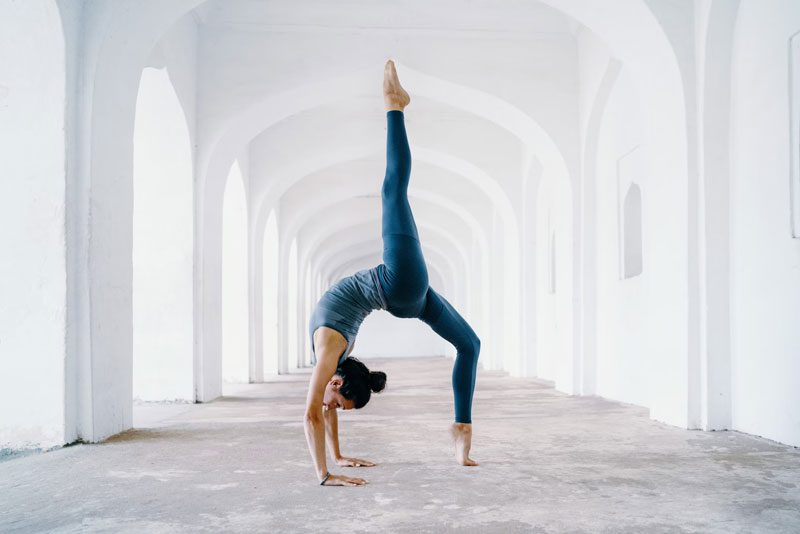
Can you reach the top shelf without wincing? Carry a heavy grocery bag from the car without your back complaining? Tie your shoes without a small groan?
That is flexibility at work. Not the splits. Not a yoga photo. Just moving freely through an ordinary day.
Most of us learned to stretch the way we were taught at school: a few quick holds, and a lot of hope. In this article I want to tell you what flexibility is, show you what the research says (some of it surprised me when I looked closely), and give you a routine you can start today.
What flexibility is
Flexibility is the range of motion around a joint and how comfortably you can use it. Muscles, tendons, ligaments, skin and the joint itself all play a part, and people vary a lot in how flexible they are naturally.
Stretching is the practice. Flexibility is the result.
For years we assumed stretching works by lengthening muscles. The current evidence points somewhere else. A 2025 review pooled 65 trials and found that <cite index=”157-1″>weeks of stretching moderately raise stretch tolerance and slightly reduce stiffness, while muscle fibre length does not change</cite> (Sports Medicine, 2025; plain-language summary). An earlier review of 26 studies reached a similar view: <cite index=”161-1″>three to eight weeks of stretching increased stretch tolerance but did not markedly affect the mechanical properties of the muscle-tendon unit</cite> (Freitas et al.).
What does this mean for you? Regular stretching teaches your nervous system that the end of your range is safe to visit. You do not need to force a joint. You need to keep showing up, which is why consistency matters more than intensity.
Try: Run a simple test today. Stand with straight knees, bend forward slowly, and measure how far your fingertips reach toward the floor (or whether they reach at all). Write the number down. Repeat in four weeks. This is a personal benchmark, not a clinical test.
The four types of stretching
- Static: you move into a position and hold it, steadily and without bouncing. Examples are a calf stretch against a wall or a seated hamstring stretch. It suits almost everyone.
- Dynamic: you move a joint through its full range with control, such as arm circles, leg swings or walking lunges. Dynamic work suits warm-ups well.
- PNF (proprioceptive neuromuscular facilitation): you stretch, contract the muscle gently against resistance, then ease into a deeper stretch. It is usually done with a partner.
- Passive or assisted: a strap, a wall, a bench or another person helps you into the position.
The American College of Sports Medicine (ACSM) says static, dynamic, ballistic and PNF stretching can all improve range of motion (ACSM summary). So the best method is the one that fits your body and that you will repeat. For most people, that means static stretches after a session and dynamic moves before it.
One practical tip: stretch when you are warm. ACSM suggests light aerobic activity, or even a warm bath, before stretching (ACSM summary). Stretching cold muscles is not forbidden, but it is less comfortable and less productive.
How long, how often, how hard
Here is what ACSM recommends for most adults:
| Variable | Recommendation |
|---|---|
| How often | At least 2 to 3 days a week. Daily stretching gives greater gains |
| How hard | To the point of tightness or slight discomfort, never pain |
| How long | 10 to 30 seconds per hold for most adults. Older adults can hold 30 to 60 seconds |
| Repeats | 2 to 4 times per stretch, building up to about 60 seconds in total |
Sources: ACSM guideline summary and ACSM recommendations.
You will still see advice for 40 to 60 second holds, repeated several times. That goes beyond what the guideline asks for, and it can make a routine feel like a chore. Start with a 20-second hold, repeated twice. As it gets easier, move to three repeats. That gets you to about a minute per stretch without the grind.
Myths worth dropping
Myth 1: “Static stretching before exercise is bad.” The truth depends on how long and what comes next. A systematic review found that <cite index=”145-1″>greater performance deficits occurred with static holds of 60 seconds or more per muscle (-4.6%) than with holds under 60 seconds (-1.1%)</cite> (Behm et al., 2016). A 2019 review concluded that <cite index=”130-1″>short static stretching of 60 seconds or less per muscle trivially impairs subsequent strength and power activities</cite> when it sits inside a full warm-up (Chaabene et al., 2019).
In practice: before a light session, a short hold is fine. Before heavy lifting or explosive work, start with dynamic moves and save long static holds for afterwards.
Myth 2: “Stretching prevents injury.” The evidence here is weaker than many of us were told.(ACSM guideline summary).
A later narrative review on dynamic stretching reported that it gives positive impact (Sports Medicine, 2023).
So warm up properly, build strength, and do not treat a few static holds as insurance.
Myth 3: “Stretching cures sore muscles muscle stretching, whether conducted before, after, or before and after exercise, does not produce clinically important reductions in delayed-onset muscle soreness in healthy adults. (Herbert et al., 2011). Stretch because it improves your range of motion, not to prevent next-day aches.
Myth 4: “The more flexible, the better.” Not always. Looseness without control is not an advantage. A joint that moves far but cannot be held steady under load is a weakness. Work strength through your new range, not just the range itself.
Pick the myth you believed most. Change one habit this week because of it.
Do: A 10 to 15 minute routine
Do this at least three days a week, and more if you can. Stretch after your session, and warm up before it.
1. Warm up (3 minutes). Brisk walking, marching on the spot or easy cycling. Enough to feel your heart rate rise and your body warm.
2. Dynamic moves (3 minutes), 8 to 10 controlled reps each:
- Arm circles, forwards and backwards
- Leg swings, front to back, then side to side
- Hip circles
- Cat-cow, moving slowly with your breath
3. Static stretches (6 to 8 minutes), 20 seconds per hold, 2 rounds (3 when comfortable):
- Calf stretch against a wall, both legs
- Standing hamstring stretch: one foot on a low step, hips back, back flat
- Kneeling hip flexor stretch, both sides
- Doorway chest stretch
- Upper back stretch: arms forward, round the upper back, let the head drop
4. Breathe. Exhale slowly as the stretch eases. Holding your breath raises tension.
How to progress over four weeks
- Week 1: Three sessions. Hold each stretch 15 to 20 seconds, 2 rounds. Focus on the warm-up.
- Week 2: Three to four sessions. Hold 20 seconds, 2 rounds. Add one extra dynamic move.
- Week 3: Four sessions. Hold 20 to 30 seconds, 3 rounds on your tightest areas.
- Week 4: Repeat the toe-reach test. Compare with your starting number. Note how you feel moving, not just the number.
Safety rules
- Seek your medical doctor’s approval first if you have a recent fracture, infection, inflammation, severe pain or any medical condition. This article is general information, not a personal assessment.
- Stretch to tightness or mild discomfort. If it hurts sharply, back off.
- Stop and seek advice if you notice numbness, tingling, swelling, or a joint that feels unstable.
- No bouncing in static holds.
- Do not force a movement, and do not stretch a weak or injured muscle hard on your own.
- If your flexibility has been limited for a long time, or you have an injury, ask a qualified professional to assess you and build a plan around your needs.
What you gain
Regular flexibility work gives you more motion around your joints. For most adults, ACSM notes that <cite index=”120-1″>flexibility training will help to improve balance and postural stability</cite> (ACSM guideline summary). Paired with strength and aerobic exercise, that means reaching, bending, twisting and carrying feel less effortful in daily life.
Keep your expectations realistic. Stretching will not remove every ache or stop every injury. Do it because it helps you move better and feel more at ease in your body.
Your next step
Today, take the toe-reach test. This week, complete three short sessions with a warm-up, a few dynamic moves and 20-second holds. In four weeks, test again.
Flexibility is not a gift some people are born with. It is a habit you build. Tell it. Show it. Do it.
Further reading https://Evexia365.com
References
- Ingram et al. Mechanisms underlying range of motion improvements following acute and chronic static stretching: a systematic review and meta-analysis. Sports Medicine, 2025. https://doi.org/10.1007/s40279-025-02204-7 ; plain-language summary: https://www.painscience.com/biblio/flexibility-gains-due-to-boosted-tolerance.html
- Freitas SR, Mendes B, Le Sant G, Andrade RJ, Nordez A, Milanovic Z. Systematic review and meta-analysis on the chronic effects of stretching on muscle-tendon unit properties. https://research-repository.griffith.edu.au/server/api/core/bitstreams/001f98aa-72a0-46e6-b209-15f86fe06ec7/content
- Garber CE, et al. Quantity and quality of exercise for developing and maintaining cardiorespiratory, musculoskeletal and neuromotor fitness in apparently healthy adults (ACSM position stand), 2011. Summaries used: https://www.anatomytrains.com/wp-content/uploads/manual/acsm.docx ; https://www.hcplive.com/view/new-recommendations-answer-question-how-much-exercise-enough ; https://fit-pro.com/print-article-2209-permanent.html
- Behm DG, Blazevich AJ, Kay AD, McHugh M. Acute effects of muscle stretching on physical performance, range of motion, and injury incidence in healthy active individuals: a systematic review. Appl Physiol Nutr Metab 2016;41(1):1-11. https://pubmed.ncbi.nlm.nih.gov/26642915/
- Chaabene H, Behm DG, Negra Y, Granacher U. Acute effects of static stretching on muscle strength and power: an attempt to clarify previous caveats. Front Physiol 2019;10:1468. doi:10.3389/fphys.2019.01468
- Narrative review on dynamic stretching and injury incidence. Sports Medicine, 2023. https://link.springer.com/article/10.1007/s40279-023-01847-8
- Herbert RD, de Noronha M, Kamper SJ. Stretching to prevent or reduce muscle soreness after exercise. Cochrane Database Syst Rev 2011;(7):CD004577. doi:10.1002/14651858.CD004577.pub3. https://pubmed.ncbi.nlm.nih.gov/21735398/
Educational content only. Please seek your medical doctor’s approval before starting any new stretching or exercise programme, especially if you have an existing condition, an injury or a recent medical problem.