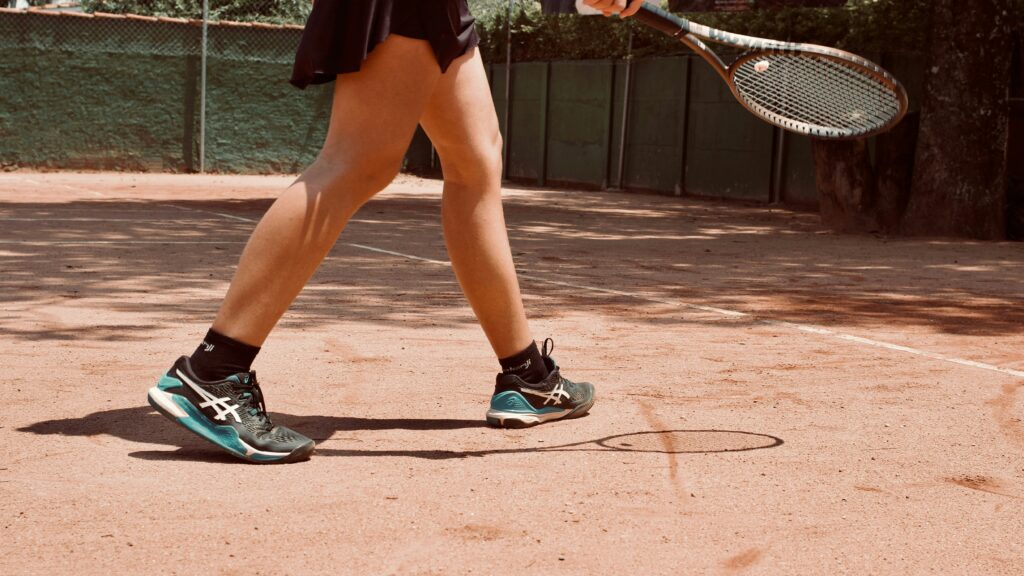
“Research shows that even elite youth players suffer a significant drop in serve precision when their heart rates remain elevated (Bilić et al., 2023).”
In 2026 era of tennis, the “superhuman” Players isn’t just the one who hits the hardest; it’s the one who recovers the fastest. We often view tennis as a series of explosive, anaerobic bursts—and while that’s true for a single forehand, a three-set match is an aerobic marathon composed of anaerobic sprints. Simply stated it is demanding work from both worlds.
As a coach or player , we must reframe aerobic fitness. It isn’t about training to run a slower marathon; it’s about physiological restoration. It’s the engine that cleans the “exhaust” out of your muscles so your brain can stay sharp and your technique remains fluid in the fifth set. refer our other articles
Tennis Match Burn https://ranilharshana.com/tennis-fitness/the-match-burn-tennis-endurance/
Oxidative Stress in Tennis : https://ranilharshana.com/tennis-fitness/oxidative-stress-and-tennis-players/
LTAD : https://ranilharshana.com/tennis-fitness/ltad-for-tennis-players-2/
Over Training : https://www.youtube.com/watch?v=Iq-Sgh0el8U&pp=2AYk
The O2 of TENNIS Performance
Before stepping onto the court, we must establish the benchmarks for competitive readiness. Research indicates that a aerobic foundation is the base for high-level play.
| Tennis-Specific Target | Training Implication | |
| VO₂ Max ( Base) | Males: >50ml/kg/min Females: >42ml/kg/min | Benchmark for competitive readiness. |
| Effective Playing Time | 10–30% of total match time | Train the recovery system, not just the “on” time. |
| Modality | HIIT & On-Court Training (OTT) | Mimics multidirectional match demands. |
| Work-to-Rest | 1:3 to 1:5 | Mirror actual point/rest structures. |
Why Aerobic Fitness is a Tactical Weapon OF TENNIS
Many players neglect the aerobic system because points are short. However, science tells a different story. According to Fernandez-Fernandez et al. (2009), a high VO₂ max is what promotes faster heart rate recovery and lactate clearance between points.
1. The “Clear MIND” Factor
When you are aerobically fit, you play at a lower relative intensity. While your opponent is gasping for air and losing the ability to calculate angles, your brain remains oxygenated. This preserves executive function—the ability to decide between a cross-court dip or a down-the-line winner under pressure.
2. MaINTAIN Technical Integrity
Fatigue is the enemy of tennis technique. As the aerobic system fails, the “big muscles” (Quads, Glutes & Hams) , leading to “lazy feet” and altered swing paths. High aerobic power ensures you can maintain your knee bend and racket-head speed from the first serve to the final match point in super tie breaker.
3. ReCHARGE the “Battery”
Your explosive movements rely on Phosphocreatine (PCr). The aerobic system is responsible for PCr resynthesis. Without a strong aerobic engine, your “explosive” movements become progressively slower as the match drags on.
How to Train: Beyond the Treadmill oR RUNNIG
To achieve resilience, we must move away from steady-state jogging and toward sport-specific intervals.
High-Intensity Interval Training (HIIT)
HIIT is the gold standard for boosting VO₂ max while maintaining muscle power.
- The Protocol: Running bouts of 30 seconds to 4 minutes at 90–100% of maximum velocity.
- The Ratio: Use a 1:1 to 1:4 work-to-rest ratio to simulate the intensity of a heavy baseline rally followed by the walk back to the line.
On-Court Tennis Training (OTT)
Why run in a straight line when tennis is played in 360 degrees?
- “X Drill”: Hit four corners of the court in an ‘X’ pattern for 30 seconds at max effort.
- The Goal: Perform 6–8 repetitions. This forces the body to adapt to the specific metabolic waste produced during lateral lunging and rotational loading.
Repeated Sprint Ability (RSA)
This involves all-out sprints (≤10 seconds) with incomplete recoveries. This is the “secret sauce” for tennis fitness, as it directly improves the ability to perform consecutive explosive moves without a drop in speed.
Strategic TRAINING : Don’t Burn Out
To optimize your physiology, the order of your training matters please rede the below links on books, and articles for further reference
- Skill & Power First: Always perform your most “neurologically demanding” work before your aerobic conditioning.
- Surface Awareness: Training for the clay season? Increase your work intervals. Clay court rallies are significantly longer than those on grass or hard courts, demanding a higher aerobic ceiling.
- The Base: Once a week, perform a 30–40 minute “Long Slow Run” at 60–70% of max heart rate. This builds capillary density and joint resilience, acting as the foundation for your high-intensity work.
By integrating these aerobic strategies, you aren’t just getting “fitter”—you’re becoming a more dangerous tactical player.
Junior and Recreational player must read Tennis Fitness Book https://www.amazon.com/shop/ranilharshana/list/KPDXGXUSWV2L?ref_=aipsflist
Competitive Travelling Coaches and player : Tennis Wellness & Performance https://www.amazon.com/dp/B0DPL48X51
Tennis Equipment : https://www.amazon.com/shop/ranilharshana/list/1A104W2N5FIHY?ref_=aipsflist
Worlds First Tennis AI Ball Machine : https://sportbot.tech/ Code : Cochran for global discount on checkout
Tennis Related Books : https://www.amazon.com/shop/ranilharshana/list/KPDXGXUSWV2L?ref_=aipsflist
Mind Set : https://www.amazon.com/WHEN-LIFE-SHOCKS-YOU-WHAT/dp/B0D3RBPWFC/
Reference
Bilić, Z., et al. (2023). Exercise-induced fatigue impairs change of direction performance and serve precision among young male tennis players. Sports, 11(3), 56.
Fernandez-Fernandez, J., et al. (2009). Intensity of tennis match play. British Journal of Sports Medicine, 43(11), 785–790.
Glaister, M. (2005). Multiple sprint work: Physiological responses, mechanisms of fatigue and the influence of aerobic fitness. Sports Medicine, 35(9), 757–777.
Kilit, B., & Arslan, E. (2019). Effects of high-intensity interval training vs. on-court tennis training on aerobic and anaerobic capacity. Journal of Strength and Conditioning Research, 33(5), 1289–1296.
Kovacs, M. S. (2007). Tennis physiology: Training the competitive athlete. Sports Medicine, 37(3), 189–198.