
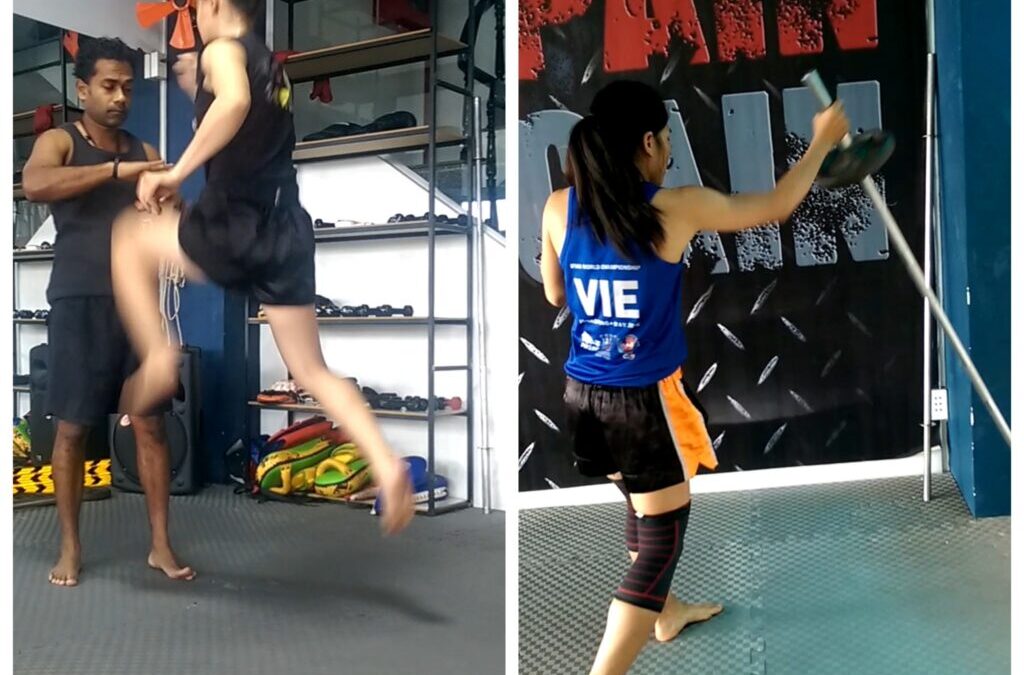
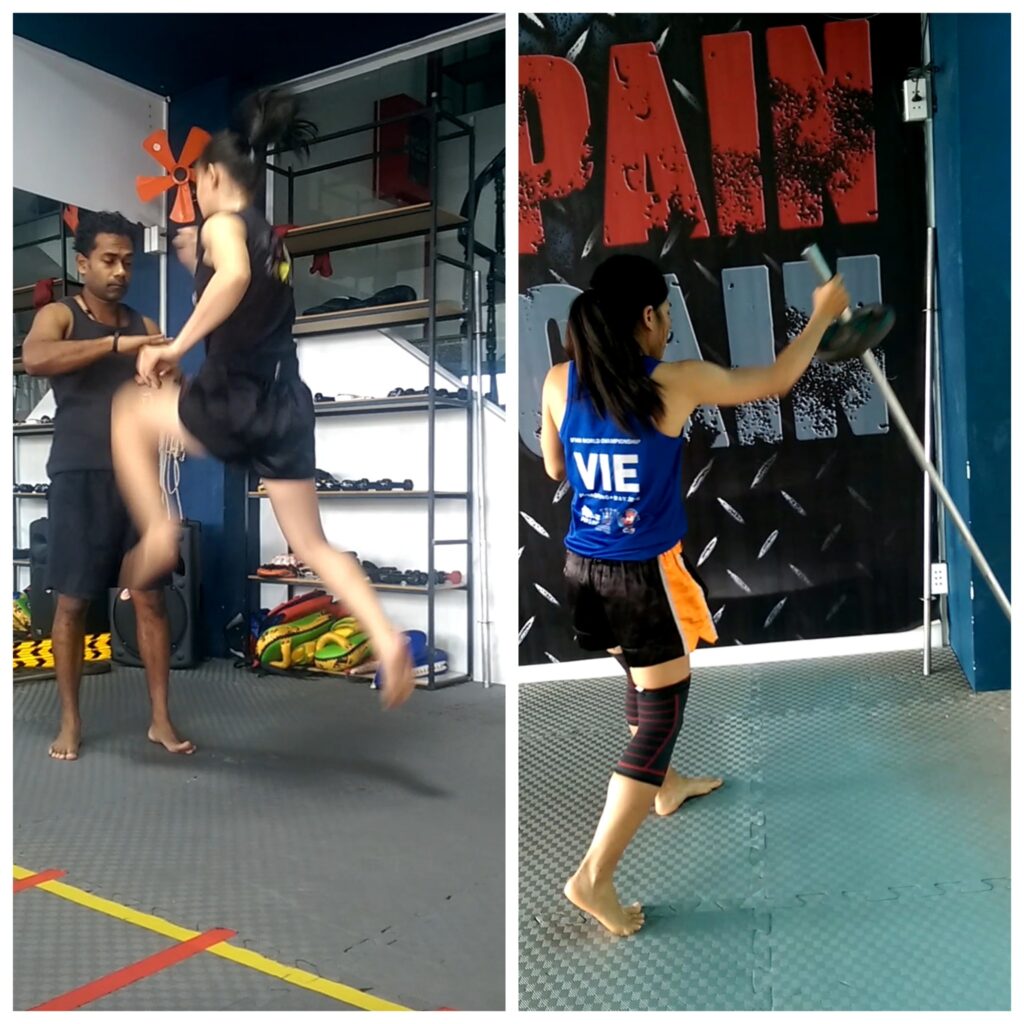
In every combat sports , a familiar figure exists: the “GYM/Workout/bag/pad warrior.” Boasts an impressive bench press etc., convinced this raw strength or copying technical movement with some fitness from social media guarantees a knockout punches or kicks. Yet, when they throws, the strike often lacks the penetrating snap and concussive force that separates armature from elite champions. The disconnect isn’t about effort; it’s about physics and with practical understanding. When the real coaches in Technical or S&C design plans there is method do the chaos . Its is not random ! We Have solid individualized periodize plan for each athlete. This article only covers one small aspect of combat sports & performance.
This article does not contain random ideas, these forged with almost 3 decades of science and of practical’s filed wok with multiple World, Asian and South East Champions in multiple countries. Some links with few of the athletes
https://studio.youtube.com/video/G0nAypJ06VQ/edit
https://studio.youtube.com/video/dYiVs4kUnT4/edit
https://studio.youtube.com/video/eGcgtjAIq_o/edit
https://studio.youtube.com/video/qnKLk7pF8Ag/edit
Biomechanics reveals a fundamental truth: brute “pushing” power is insufficient for elite striking. A knockout is an act of kinetic physics, executed through a perfectly synchronized chain of joints and muscles towards the opponent. To develop genuine fight-ending power, an athlete must move beyond bodybuilding and copying rending so called functional social media hype and forge the body into a single, whip-like unit, generating force explosively from the ground up (Filimonov et al., 1985).
Why ONLY “Arm & leg STRENGTH” IS INSUFFIECIENT
In the dynamic chaos of a fight, you are not pressing or pulling a stationary barbell, dumbbell or cable . You are generating force against a moving, resisting opponent while simultaneously managing gravity, stability, agility, reaction , balance, and your own defensive structure. Relying primarily on the limbs leads to slow, energy-draining “arm punches or leg kicks ” that rarely produce decisive results.
Research consistently shows a contrast between novices, armatures and elites. While novices over-rely on deltoid and triceps activation, elite strikers generate the overwhelming majority of their power from the, ground, legs and trunk, using the arm merely as the final, guided delivery vehicle (Lenetsky et al., 2013). The arm’s & leg’s role is not to generate force, but to transfer it efficiently from a rotating core to the target. True power is not pushed from the shoulder; is cracked like a whip from the floor. This also relates to kicks as its now push from the knee.
The ART of the Kinetic Chain: Your Body as a Weapon
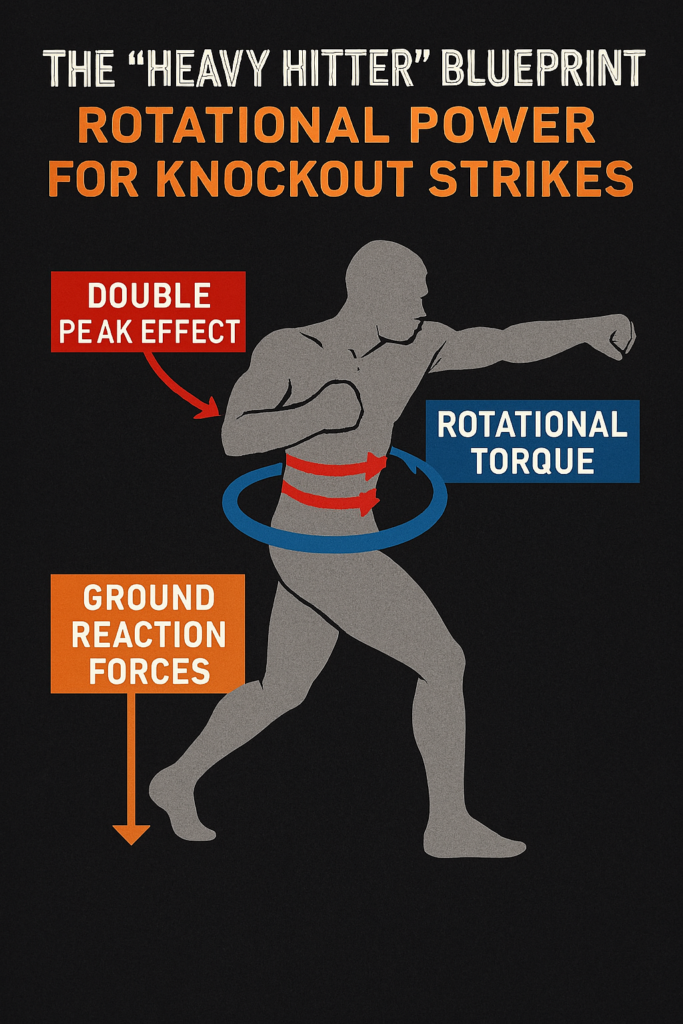
Visualize your body not as a collection of parts electrical contraction helping as an interconnected kinetic chain—a whip. Power (Speed x Strength) originates at the “handle” (your feet driving into the floor) and accelerates through the links (ankles, knees, hips, torso, shoulders) to the “tip” (your fist, knee, elbow, or shin). The efficiency of this chain determines your power. This relies on four biomechanical structures :
- Ground Reaction Forces: Every knockout strike ever landed began with an intentional, violent application of force into the ground. The floor is your power source; without a solid connection, the chain breaks.
- Rotational Torque: Your core and hips function as a high-torque engine. They take the linear force from your legs and multiply it through rapid rotation. A punch, in essence, is a vertical push from the legs turned horizontal by the hips.
- The “Double Peak” & Stretch-Shortening Cycle (SSC): Elite strikers don’t just fire muscles once. Electromyography shows a “double peak” of activation: one burst to initiate the rotation (creating a pre-stretch in the core), and a second, critical burst to rigidly brace the entire core at the moment of impact (McGill et al., 2010). This bracing prevents “energy leaks,” ensuring maximum force is delivered into the target, not dissipated through a loose torso. This process leverages the SSC, where muscles are rapidly loaded before contracting, resulting in significantly greater force output.
- Upper-Lower Body Separation: This is the secret to storing elastic energy. The ability to rotate the shoulders independently of the hips creates torsional tension across the core—like winding a spring. The subsequent unwinding releases this energy as explosive rotational speed.
The fundamental rule is absolute: If your feet are passive and your hips are square, you are not hitting. You are merely reaching, and you are vulnerable.
The Three-Phase Power Progression
Jumping directly into high-velocity rotational throws without a foundation is a direct path to injury and inefficient movement. Real power must be built systematically, layer by layer. This is why we train our athletes with proper initial and periodic assessment from health, performance , technical using individualized periodization in Technical and non Technical (S&C, Nutrition, Mind Set, Recovery ) . Provided you have solid training base in S&C, and Technical fundamentals and to be in line with this article let focus on the below
- Phase 1: Rotational Mobility & Stability
Before you can generate power, you must have the range of motion to do so safely and the stability to control it. Fighters often develop a stiff thoracic spine (mid-back) from constant guard postures. When the thoracic spine can’t rotate, the lower back (lumbar spine) is forced to compensate, leading to poor mechanics and injury.- Focus: Daily thoracic mobility drills and core anti-rotation training builds the stiffness needed to create a stable base against rotational forces.
- Phase 2: Rotational Strength
Strength is the foundation upon which power is built. This phase uses controlled, loaded movements to develop the muscular capacity to produce and withstand high levels of rotational force.- Focus: Exercises like Landmine Twists and Cable Woodchoppers. These movements directly strengthen the myofascial slings—the diagonal networks of muscle and fascia (e.g., from the right hip to the left shoulder) that are the primary engines for punches and kicks (Santana et al., 2007).
- Phase 3: Explosive Rotational Power
This phase bridges the gap between gym strength and fight power. The goal is to train the body to produce maximum force at high speed.- Focus: High-velocity, ballistic movements like Rotational Medicine Ball Throws, Jumps and Slams. Power must come from a violent hip pivot and core snap, not from falling forward with body weight. This trains the critical Stretch-Shortening Cycle under load.
The Power : BASIC Exercises
Incorporate these movements into your strength and conditioning regimen to build a complete, fight-ready power. Focus on quality of movement over weight lifted. NOTE : THESE ARE EXAMPLES, EACH FIGHTER SHOULD BE PERIDODIZED SEPERATELY .
| Exercise | Primary Benefit | Coaching Tip | Application |
|---|---|---|---|
| Landmine Rotation | Develops rotational strength & core stiffness | “Pivot the back foot ; imagine spearing the bar through a target.” | The core mechanic of a power cross or roundhouse kick. Builds the oblique strength to whip the hip over. |
| Rotational Med Ball Slam | Trains explosive power & the “snap” of the Stretch-Shortening Cycle. | “Slam diagonally with intent; retract the ball as fast as you throw it.” | Teaches rapid strike retraction. |
| Split Squat | Builds unilateral leg strength & stability—the foundation of your stance. | “Keep torso upright; drive through the front heel. | The stable base for converting forward momentum into rotation on punches. |
| Medicine Ball Shot Put | Trains horizontal & rotational power transfer from the rear leg. | “Drive off the back leg and push the ball forward, don’t just throw it.” | Mimics the kinetic chain sequencing for strikes |
| Pallof Press | Develops core stability to resist rotation, preventing energy leaks. | “Fight the cable’s pull to twist you. Maintain a solid, square torso.” | The stability needed upon impact to ensure force goes into the opponent, not into spinning your own body. |
The Non-Negotiable: Single-Leg Strength
Because combat is fought primarily from a staggered stance and every kick is thrown from a single-leg base, developing unilateral strength is paramount. Exercises like the Bulgarian Split Squat and Rear-Foot Elevated Split Squat are not accessories; they are essentials. They build the balanced, anchored strength required to generate power without compromising balance (Bourgeois et al., 2017).
From Gym Power to Ring Knockouts
The path to becoming a “Heavy Hitter” is not measured in plates on a barbell but in the efficient, explosive transfer of energy from the ground to the target. It is forged through the disciplined, intelligent application of rotational physics, not just maximal strength.
Stop training like a statue pushing weight. Start engineering your body to move as a coordinated, ruthless kinetic chain. Step by step progression from mobility, stability, to strength, to explosive power. Integrate exercises that build the specific stability and snap your strikes require. When you do, you will stop reaching and start delivering strikes with true fight-ending intention.
The final question for any serious striker is this: Are you content with being strong in the gym or doing fancy exercises , or are you committed to becoming devastating in the ring?
Wellness book how ancient martial arts around the globe, food , dance, medicine incorporated into different cultures https://www.amazon.com/WELLNESS-EVEXIA-365-CCCLXV-Perspective/dp/B0CDZ21SNN/
Mind Set, when life hits you : https://www.amazon.com/WHEN-LIFE-SHOCKS-YOU-WHAT/dp/B0D3RBPWFC/
Martial Arts & Combat Equipment : https://www.amazon.com/shop/ranilharshana/list/3GNLY495KX0P5?ref_=aip_sf_list_spv_ofs_mixed_d
Sports Supplements https://www.amazon.com/shop/ranilharshana/list/3BCJCA3IIRA9D?ref_=aip_sf_list_spv_ofs_mixed_d
Sports & Wellness Recovery Tools : https://www.amazon.com/shop/ranilharshana/list/2IQCZDHXGRNEC?ref_=aip_sf_list_spv_ofs_mixed_d
References
- Bourgeois, F. A., et al. (2017). Influences of 1, 2, or 3 sessions per week of vertical jump and weightlifting on the development of strength and power. Journal of Strength and Conditioning Research.
- Filimonov, V. I., et al. (1985). Means of increasing the effectiveness of preparation of women boxers. Soviet Sports Review.
- Lenetsky, S., et al. (2013). The physical determinants of punching power in boxing: A qualitative review. Journal of Strength and Conditioning Research.
- McGill, S. M., et al. (2010). Determinants of boxing punch speed and punch force. Journal of Strength and Conditioning Research.
- Santana, J. C., et al. (2007). A Kinematic and Kinetic Comparison of a 2-Handed and 1-Handed Standing Cable Press. Journal of Strength and Conditioning Research.